Editorial guide
Are Piraeus ferries safe?
Short answer: For most travellers, yes. Greek passenger ferries are regulated commercial ships, surveyed and inspected under national and international maritime rules, crewed by certificated seafarers and subject to inspection by port authorities. The system's most visible safety feature is that sailings are cancelled or delayed when weather makes them unsafe, a cancelled ferry is the system working, not failing. The realistic risks for a visitor are missed connections, heat, slips on gangways, seasickness and theft, not a sinking. The biggest safety decision you make is usually how much buffer you leave around a flight or a fixed booking.
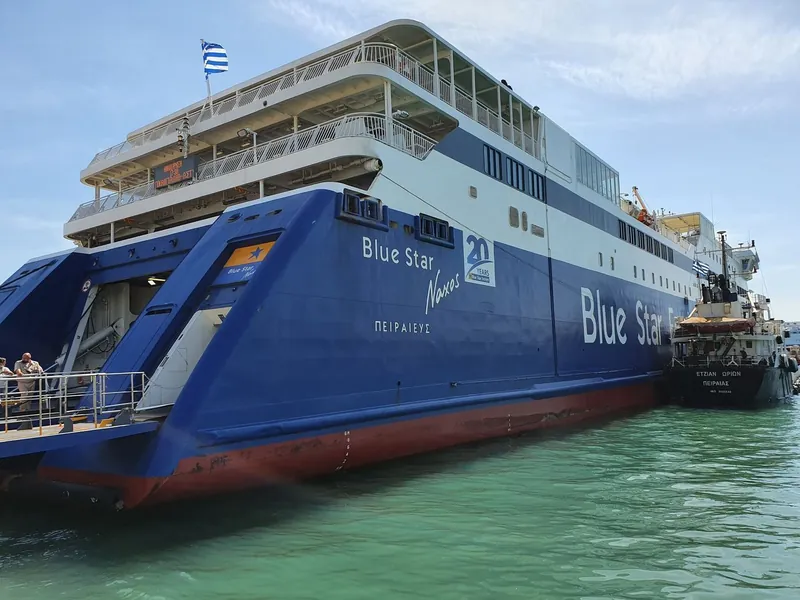
Piraeus is a working port, not a resort marina. The sea state, especially in summer when the meltemi blows, is the variable most likely to disrupt a sailing.
Safety rules, vessel assignments and weather thresholds change. Follow crew instructions, the operator's notices and the coast guard/port authority on the day.
What "regulated" means in practice
- Flag-state and class surveys. Passenger ships are built and maintained to classification-society rules and surveyed by the flag state. They cannot operate without valid certificates.
- Port inspections. Port authorities can board and detain vessels for safety, crewing or documentation deficiencies.
- Crew certification. Officers and crew hold STCW certificates, with additional training for passenger ships, fire-fighting, survival craft and crowd management.
- Safety equipment on board. Life jackets, life rafts, fire detection and suppression, muster stations, emergency lighting and evacuation routes are standard. Safety cards and announcements are usually in Greek and English.
- Weather limits. Port authorities and operators restrict or cancel sailings when conditions exceed a vessel's safe operating limits. There is no single Beaufort limit for all ships. The decision depends on the vessel, the route and the port.
- Emergency response. The Hellenic Coast Guard coordinates search and rescue, and ferries are required to assist vessels in distress.
The correct question is not "are ferries perfectly safe?" but "what are the realistic risks on my route, and how do I reduce them?"
Where the real risks are
The ratings below are our judgement, not measured data.
| Risk | Our judgement | How to reduce it |
|---|---|---|
| Missed ferry or connection | Moderate; the most common failure | Build buffers; go to your gate early; check the ticket |
| Weather cancellation or delay | Moderate in July–August | Check notices; keep a spare day |
| Seasickness | Common on high-speed boats in chop | Medication before boarding; get on deck if you feel unwell |
| Slips, trips and falls | Underestimated | Wear grippy shoes; use handrails; avoid running on wet decks |
| Heat exhaustion | High in summer | Water, shade, hat; do not queue for hours in the sun |
| Theft | Low but real in crowds | Keep valuables on you; do not leave bags unattended |
| Vehicle-deck incident | Very low | Follow marshalling; do not access the deck under way |
| Serious vessel casualty | Very low | Follow safety briefing; know your muster point |
Weather: the meltemi and cancelled sailings
The meltemi is a dry northerly wind that blows across the Aegean mainly from mid-June to early September. It brings clear skies, strong winds (often force 6–7, sometimes higher), and short, steep seas in exposed straits.
- High-speed catamarans are affected first. They are light, slam in a short sea and have lower tolerance than conventional ships. They slow down before they cancel.
- Conventional ferries often keep sailing in stronger wind. Larger hulls and stabilisers make them more comfortable in a chop.
- Cancellations are normal and safety-driven. Operators publish itinerary modifications; port authorities can impose local bans. A cancelled sailing is not a sign of an unsafe operator.
- Conditions differ by route. The northern Cyclades and the Kafireas strait are rougher than the sheltered Saronic Gulf. Piraeus harbour can be calm while the route is not.
- Morning sailings are often calmer, because the wind tends to build through the afternoon.
If you are prone to seasickness or travelling with children or pets, choose the conventional ferry on a windy forecast, even if it is slower.
Vessel differences that matter
- Conventional ferries (Blue Star, ANEK, Minoan) are heavier, more stable, have open decks and more space. They are the better choice in wind, for families and for anyone who wants to walk around.
- High-speed catamarans (Seajets and similar) are fast and enclosed. They are comfortable in calm weather and unpleasant in chop.
- Older ships are not automatically less safe, but they vary in comfort, noise and cabin quality. Safety certification is not the same as modern decor.
- Small Saronic ferries and hydrofoils operate in more sheltered waters but have less space and fewer facilities.
There is no "safest operator" list worth relying on. Choose the vessel type and route that match the conditions and your needs.
On board: what to do
- Watch or read the safety briefing. Locate your muster station, life jackets and exits.
- Know where your life jacket is in your cabin or seat area. Crew will demonstrate if asked.
- Keep children supervised, especially on open decks, stairs and gangways.
- Use handrails. Decks can be wet, oily or moving.
- Do not access the vehicle deck during the crossing unless crew explicitly allow it.
- Store luggage safely so it does not block aisles or emergency exits.
- Report anything that looks wrong to crew, not just to other passengers or later in a review.
- Follow crew instructions immediately in an emergency. They are trained for crowd management; arguing costs time.
Families, children and vulnerable travellers
- Conventional ferries are easier with pushchairs, young children and grandparents: more space, lifts on some ships, open decks.
- Book seats or a cabin together and keep the booking confirmation accessible.
- Bring water, snacks and sun protection. Terminal queues and open decks are exposed.
- Seasickness medication for children only on medical advice.
- Travellers with reduced mobility should request assistance at booking and confirm it in writing; not every ship has an accessible cabin or lift. See Piraeus port wheelchair accessibility.
- Pets should be booked and documented in advance; see Pets on ferries from Piraeus.
Plan around flights and fixed bookings
For most visitors, the highest-consequence risk is missing a flight or a fixed commitment because a ferry was delayed or cancelled.
- Do not put a non-rebookable international flight on the same day as a ferry. Return to Athens the day before.
- Build a spare day before anything that cannot move.
- Know your backup sailing and the next port option.
- Buy travel insurance that explicitly covers ferry delays and missed connections if the trip depends on them.
See Piraeus ferry and flight same day and Ferry cancelled due to wind.
FAQ
Are ferries from Piraeus safe for families?
Yes, for most conditions, especially on conventional ferries with open decks and more space. Choose a calm-weather window, book seats together and keep children supervised on deck and stairs.
Do Greek ferries sink more often than ferries elsewhere?
This guide does not compare accident rates between countries. The practical point is that weather cancellations and inspections are active safety controls, not evidence of an unsafe system.
Are high-speed catamarans unsafe in the meltemi?
They are less comfortable and more likely to be cancelled, not automatically unsafe. Operators stop them when conditions exceed their limits.
Can I choose a safer ferry?
Choose by vessel type and conditions: conventional in wind, high-speed in calm weather when time matters. Check the operator's notices and follow crew instructions.
Should I bring my own life jacket?
No. Life jackets are provided on board and stowed in cabins or at muster stations. Personal equipment is not a substitute for the ship's certification and crew procedures.
What should I do in an emergency?
Follow crew instructions, move to your muster station and keep passages clear. The on-board section above covers what to expect.
Last checked
Dated 21 October 2026. Use the notice at the top of this guide, and the crew and official notices on the day.
Disclosure
This article contains practical recommendations and links that may qualify as affiliate links. If you book through an affiliate link, the site may earn a small commission at no extra cost to you. Affiliate links are not placed inside safety-critical steps.
Further planning
- Guide: Ferry cancelled due to wind
- Guide: Fast ferry vs conventional ferry
- Guide: Piraeus ferry and flight same day
- Guide: Common Piraeus ferry mistakes
- Guide: Piraeus port wheelchair accessibility
- Guide: Pets on ferries from Piraeus