Editorial guide
Fast ferry vs conventional ferry from Piraeus
Short answer: Choose the fast (high-speed) ferry when time is the constraint and the forecast is benign; choose the conventional ferry when it is windy, you are carrying a vehicle or large luggage, you get seasick, or you want the journey itself. The price gap is real (a high-speed is commonly ~1.5–2× the equivalent conventional), the comfort trade-off is real, and the reliability gap is the biggest: conventional ferries keep sailing in weather that grounds the high-speeds. Fast for time, conventional for everything else.
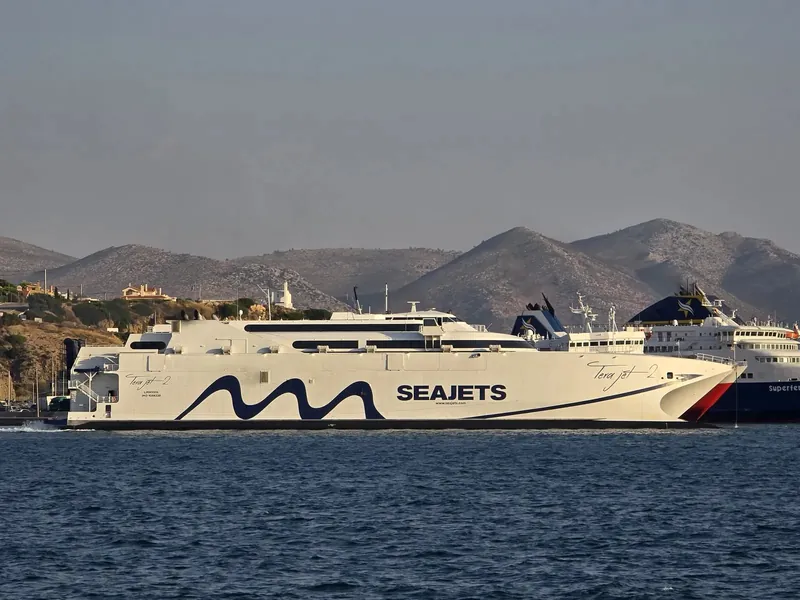
Both types sail from Piraeus on most popular routes, often with an operator for each. The comparison below is about what you actually buy, not marketing speed figures.
Vessel assignments and fares change by season and route; verify operator, vessel type and price on your exact sailing.
What "fast" and "conventional" actually are
- Conventional ferries are large car-carrying ships (Blue Star, Anek, Minoan): slower, cheaper, generally more stable, with outdoor decks, cafeterias, sometimes restaurants and cabins. They can carry cars, motorhome and motorcycles; some take trucks. Think of it as a floating bus or train: you can walk an open deck, eat and sleep.
- High-speed vessels are catamarans, monohulls and (smaller) hydrofoils (Seajets, Hellenic Highspeed, Golden Star high-speed): enclosed airline-style seating, no (or very limited) car deck on some, 2–3× the knots. Think of it as a ferry-shaped plane: fast, enclosed, with fixed seats.
Operators with both types in their fleets make different calls per route: Blue Star runs conventional ferries on the Aegean network, Seajets runs high-speeds, and Hellenic Seaways (an Attica Group sister brand of Blue Star) runs both.
Speed (the obvious one)
Typical Piraeus to Mykonos crossing times (check current timetables):
| Vessel | Type | Crossing |
|---|---|---|
| Seajets Eurochampion/Worldchampion Jet | High-speed | ~2 h 40–2 h 55 |
| Blue Star Myconos (direct) | Conventional | ~4 h 20 |
| Blue Star Paros (via Syros, Tinos) | Conventional | ~5 h 50 |
Typical Piraeus to Santorini crossing times:
| Vessel | Type | Crossing |
|---|---|---|
| Seajets (high-speed) | High-speed | ~5 h–6 h 10 |
| Blue Star (conventional) | Conventional | ~6 h 10–9 h 10 |
| Fast Ferries (conventional, multi-stop) | Conventional | ~10–11 h 30 |
On the crossings above, a high-speed saves roughly 20–40% of sea time, depending on which sailings you compare. Whether that is worth the price and the noise is the real decision.
Cost
Indicative fares per adult, one way, Piraeus to Mykonos (check current prices):
| Option | Starting fare (indicative) |
|---|---|
| Conventional, Blue Star (economy/deck) | ~€43–€53 |
| High-speed, Seajets (economy) | ~€87.70 |
On this example the fast boat costs roughly 1.5–2 times as much; the conventional also offers cheaper deck seating and a mix of fare tiers (aeroplane-type, business, day cabins). A car on a conventional sailing often costs €90–150 each way depending on size and route; the few high-speed sailings that accept cars are scarce and not necessarily cheaper. Compare the total for your party and check that the vessel actually has a car deck. What holds across the routes compared here: conventional is usually cheaper than high-speed; August costs more than shoulder season; a vehicle adds a lot.
Comfort and experience
| Aspect | Conventional | High-speed |
|---|---|---|
| Seating | Deck lounge (unreserved), reserved aeroplane-type seats, business class, cabins (longer routes) | Airline-style reserved seats assigned |
| Open deck | Yes: large open decks, wind and sun, people-watching | Little or none, mostly enclosed cabin |
| Outdoor view | Walk around; windows open to sea air | Sealed, air-conditioned, fast blur |
| Space | Plenty of room to spread out; families, children, pets easier | Tighter; bags on racks or in the garage |
| Noise/temperature | Natural; engine hum at cabins | Can be very cold air-conditioning; engine whine |
| Movement at sea | Slower, longer and steadier pitch/roll | Rapid, snappy motion in chop, worse for seasickness |
| Food | Cafeteria; restaurant and bar on big ships; you can bring/hot-pack food | Snack bars; pre-pack your own |
| Cabins | Yes on long/overnight routes (overnight to Crete etc.) | Rare; small catamarans no |
| Pets, bikes, luggage | Easier, a generous luggage allowance, outdoor areas for pets on some ships | Restricted; pets often deck/carrier-only; bikes need garage space; large bags racked |
The most underrated comfort difference is mental: conventional passengers generally travel (deck, food, view) while high-speed passengers are transported (seat, hours, arrival). On a 5-hour crossing that is a real difference in how the day feels.
Weather vulnerability: the real separator
The meltemi (dry northerly, July–August) hits the northern Cyclades (Mykonos, Tinos, Andros, Syros) hardest and classic clear-sky "perfect beach weather" can coexist with 6–7 Beaufort of wind.
- High-speeds go first. Light, slamming hulls, lower wave tolerance: port authorities and skippers ground them well before the bigger ships stop. A high-speed can be cancelled at 6–7 Beaufort.
- Conventional ferries keep sailing in stronger wind; some keep going at conditions that shut down high-speeds entirely.
- Cancellations come with limited remedies. EU Regulation 1177/2010 sets refund and re-routing rights for cancellations and long delays, and it can exempt operators from compensation in extraordinary circumstances such as dangerous weather. Operators sometimes offer the next sailing or an exchange instead; ask which applies to your ticket.
Operational point that surprises people: high-speeds often slow down before they cancel, so plan with realistic arrival times, not advertised ones.
Practical forecast-driven rule: if the forecast shows ≥7 Beaufort or strong northerlies across the Aegean, drop to a conventional ferry for that leg; if it is a connection-critical day, that rule is stronger. If you are prone to motion sickness, conventional is the gentler ship even on a mild day, the steadiness difference is not marginal in swell.
Vehicle capacity
| Vessel class | Car decks | Notes |
|---|---|---|
| Conventional (Blue Star, Anek, Minoan) | Yes, car, motorcycle, bicycle, motorhome | Declare dimensions; vehicle boarding starts early |
| High-speed (Seajets etc.) | Often none or small: motorcycles and some cars only | Always check the vessel before booking an inclusive car space |
| Saronic hydrofoils | No passenger vehicles | Cars go on conventional Saronic ferries only |
If you are taking a car, conventional is usually the simpler and right choice, and often the only one.
Overnight routes: where conventional wins outright
On long routes (Piraeus–Crete Heraklion/Chania, Rhodes, Kos, Patmos, Chios/Lesvos/Samos), conventional ferries have cabins, restaurants, proper lounges and open/enclosed decks for a ~8–16 hour/overnight run. High-speeds on these routes are less common and keep the "speed" role only on shorter legs. Cabins on overnight ferries are a legitimate alternative to a hotel + flight if you want them for comfort, not to save ferry money: €80–€130+ per cabin on Crete runs (per cabin, not per person) rather than a seat.
Which to choose by situation
| Your situation | Choose |
|---|---|
| Very limited time, calm forecast, foot passenger, money no object | High-speed (fastest sailing) |
| A tight same-day connection that depends on the shorter run | High-speed, but build a real buffer, because the timetable is not what happens on the day |
| Windy forecast (meltemi/7+ Beaufort) | Conventional (steady, keeps schedule) |
| Families, children, elderly, seasick-prone | Conventional |
| With a car, motorcycle, bicycle or mobility equipment | Conventional (check the vessel) |
| Large suitcases, cabin need, pet needing outdoor deck space | Conventional |
| Long/overnight routes (Crete, Rhodes, Dodecanese, NE Aegean) | Conventional |
| Walking deck, sunset, meal, slow travel experience wanted | Conventional |
| Short hops between nearby islands (Paros–Naxos, Milos–Sifnos) | Either, conventional's time gap is smaller here; cost often decides |
| Last summer day; ferry home next morning after your last island leg | Conventional (resilience matters most before a flight) |
Common mistakes on this choice
- Booking the fast boat because it shows "2h40" with a flight/transfer on the same day, then learning the fast boat also delays first in wind.
- Ignoring AC: high-speed cabins can be freezing; pack a layer even in August.
- Assuming a high-speed gives better views: usually the opposite: enclosed cabin, small windows and no deck to walk.
- Assuming high-speed catamarans are "stable" in any weather: they are the first to be cancelled.
- Assuming conventional means "cheapest" is automatic, on some routes operator and off-peak timings make a high-speed competitive; compare both on the same date.
- Booking a high-speed in shoulder/off-season and discovering the operator doesn't run it: fast sailings thin out or disappear from November to March, when the same route consolidates to conventional/limited service.
FAQ
Is a fast ferry from Piraeus always faster?
Yes, in sea time: on the crossings above, high-speeds take roughly 20–40% less time. But onboard prep, departure delays in wind and disembarkation differences narrow the gap on the day, so advertised figures are planning figures only.
Which is better in bad (meltemi) weather?
Conventional. Larger hull, stabilisers, higher wave tolerance. High-speeds (light catamarans) cancel at lower wind thresholds and cause more motion sickness in Aegean chop. In a forecast of 7+ Beaufort, take the conventional even at the cost of hours.
Can I take a car on a high-speed ferry from Piraeus?
On most, no: limited space and licensing to cars/motorcycles only where available; many are passenger-only. Conventional ferries carry cars, motorcycles, bicycles and (often) motorhomes. Check the vessel type before booking a vehicle space.
I'm seasick-prone. Which should I book?
Conventional, especially from Piraeus (open decks, you can lie down/outside, stabilisers on the big ships). Book a high-speed only on a short leg with a calm forecast, and take medication 30 minutes before boarding.
Last checked
Operators swap vessels and reprice seasonally; verify your exact sailing, its vessel type, any vehicle-deck limitation and the current fare before travel.
Disclosure
This article contains practical recommendations and links that may qualify as affiliate links. If you book through an affiliate link, the site may earn a small commission at no extra cost to you. Affiliate links are not placed inside safety-critical steps.
Further planning
- Guide: How early to arrive at Piraeus
- Guide: Which gate at Piraeus
- Guide: Piraeus vs Rafina for Mykonos
- Guide: Ferry cancelled due to wind
- Guide: Ferry or flight Athens–Santorini
- Guide: Ferry or flight Athens–Crete
- Guide: Overnight ferry worth it