Editorial guide
How early should you arrive at Piraeus ferry port?
Short answer: There is no single number. Plan on 45–60 minutes before departure if you are on foot at a nearby gate, 60 minutes with Blue Star, Anek or Minoan as a baseline, 30 minutes often enough for Seajets (60 with a vehicle), and 90–120 minutes if you are bringing a vehicle, more in July and August. The real margin is not the operator's boarding window. It is the walk (or shuttle ride) from where you actually enter the port to the correct gate.
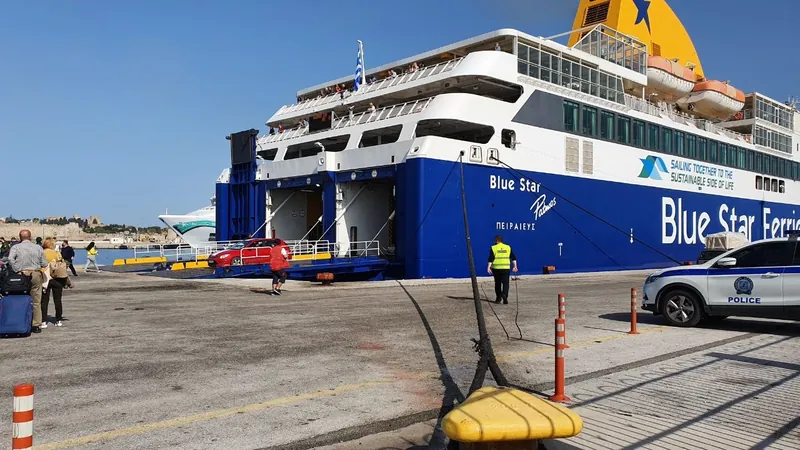
Piraeus is one of Europe's largest passenger ports, spread along roughly 2.5–3 km of waterfront. Being "at Piraeus" is not the same as being at your gate, and ferries close punctually. The honest answer is therefore: arrive by gate, not by port.
Gates, boarding windows and fares change by season; verify on your ticket and the operator's app. Timings below are typical guidance.
Why the answer is not one number
Four things move the right arrival time:
- Ship type: high-speed catamarans board for a short, firm window (often 15–20 minutes of open boarding); conventional ferries usually open boarding 30–45 minutes ahead and are more forgiving.
- Vehicle: vehicle boarding starts before foot-passenger boarding and needs space, ramps and lashing; operators set an earlier loading window.
- Gate distance: gates E6/E7 sit opposite the metro; gates E1/E2/E3 sit at the far northern end of the port. Walking end-to-end can take 20–45 minutes.
- Season: July and August add queues, coach traffic on the access roads and reassigned gates.
On top of that, some operators (Blue Star, Anek, Minoan) ask you to be at the embarkation area at least 60 minutes before departure; Seajets asks 30 minutes, or 60 with a vehicle. Where the ticket gives an operator-specific reporting time, the ticket wins.
Foot passengers: how early
| Situation | Practical arrival |
|---|---|
| High-speed (Seajets) on foot, nearby gate (E6–E9), low season, e-ticket in hand | 30 minutes before |
| Conventional ferry (Blue Star/Anek/Minoan), on foot, nearby gate, e-ticket | 45–60 minutes before |
| Any vessel, gate far from station (E1–E3), or paper ticket collection needed | 60–75 minutes before |
| Foot passenger, peak Saturday in July/August | 60–90 minutes before |
| Long-distance conventional sailing with no e-ticket / kiosk collection | add 30–60 minutes |
Allowing time for paper-ticket collection is the hidden trap: some operators ask passengers collecting from port agents to allow more time, and the ticket or operator notice should say how much. If you have an e-ticket and have checked in online, skip this and reclaim most of the margin.
Add the internal walk or shuttle on top of the operator's boarding figure, never inside it. The free port bus (E1–E5 area) and electronic departure boards are the realistic tools; with a tight window, a taxi which drops at the gate itself beats a metro.
With a vehicle: how early
Vehicle boarding starts before foot-passenger boarding on many sailings, and vehicle space can sell out before passenger seats.
- Be at the waiting area or embarkation point 60–90 minutes before departure. Operator guidance can extend this to 90 minutes or more in summer.
- Peak season / distant gate / large vehicle (campers, trailers): 90–120 minutes.
- Declare full dimensions including roof racks, bike carriers and trailers at booking; some ships take only motorcycles and cars, not motorhomes.
- The vehicle deck is normally closed during the crossing: pack a separate day bag before you board.
- Arrive earlier on peak days; vehicle check-in and lashing takes time and the loading area congests.
High-speed vs conventional: different ships, different clocks
- High-speed catamaran (Seajets etc.): short boarding window, and the ship does not wait. Boarding typically closes firmly; being on time is operationally real, not advisory.
- Conventional ferry (Blue Star etc.): boarding opens 30–45 minutes before departure, the gangways stay open longer, and loading of vehicles runs well ahead. More forgiving, though not unlimited, missed time still means missed sailing.
One scheduling point: many departures leave 07:00–09:30, and boarding starts at dawn. Early-morning bus services can be thinner than daytime ones, so do not build an itinerary that needs a 06:00 bus until you have confirmed it runs at that time.
What your arrival margin is really buying
Arriving "early" is not one task. Your window covers, in order:
- Getting from metro/bus/taxi drop-off to the gate (walk or shuttle).
- Verifying or collecting the ticket (e-ticket QR or kiosk fallback).
- Security screening of hand luggage (x-ray).
- Document check (ID/passport, plus discount documentation if applicable).
- Actual boarding and seat-deck selection on unreserved seats.
Doing them in this order keeps the margin; doing them out of order wastes it. Off-peak, 45–60 minutes is usually enough.
Peak season: add a real buffer
In July and August:
- Access roads back up and taxis take longer.
- Gates get reassigned: ships are shuffled between berths under pressure; the gate you expect may not be the gate used that day.
- Queues for ticket kiosks, security and boarding on fast Saronic boats.
- On peak weekends the "arrive 1 hour early" advice quietly becomes "arrive 90 minutes early."
Two habits that genuinely reduce missed ferries: check the electronic boards at the port entrance on the day (live berth per departure) and check your ticket the night before so the first fact you need at 05:30 is already known.
What happens if you arrive late
- A tight or past boarding deadline: no refund; your ticket is typically not refundable for late arrival. (Cancellation/refund rules otherwise vary by operator and fare class.)
- Some operators may allow a change to a later sailing for a fee / move subject to availability, but this is discretionary, treat it as a possibility, not a right, and on an August weekend there is frequently no space.
- Vehicles that miss the loading cut-off often cannot board at all.
Because ferries run on schedule to the minute, "a few minutes late" is the most expensive version of this mistake.
Arriving very early: use the time well
If you land hours ahead, Piraeus is a reasonable place to wait:
- Waiting areas, canteens and ATMs in the port (check which are open on your day).
- Mikrolimano and Zea marinas: fish tavernas, cafés and waterfront walking, a short walk from the main gates.
- The Piraeus Archaeological Museum and the Hellenic Maritime Museum at Zea, if you have time (check opening hours).
- Pre-charge phone and power bank; buy water and snacks; save the e-ticket offline.
- If you are prone to seasickness, take medication 30 minutes before boarding, not once under way.
Common arrival mistakes
- Timing from the metro station, not from the gate. The Piraeus station sits opposite the central gates around E6; an E1–E3 departure adds 20–45 minutes.
- Assuming the gate on an old guide/blog. Gate assignments change; trust the ticket and the port's live boards.
- Counting online check-in as arrival time. Online check-in saves time at the port; it does not extend the boarding deadline.
- Planning on the last boat of the day. Miss it and you are sleeping in Piraeus; the next sailing may be next morning.
- Vehicle travellers booking a high-speed catamaran that has no car deck, check vessel type before booking, not at the ramp.
FAQ
How early with a vehicle?
60–90 minutes normally, 90–120 minutes in peak season or for a large vehicle / distant gate. Vehicle boarding starts before passenger boarding and vehicle spaces sell out first.
How long is the walk between Piraeus gates?
The port runs ~2.5–3 km end to end. Metro to E6/E7 is a short walk; to E1 (Dodecanese) or E3 (Crete), 20–45 minutes on foot. A free internal shuttle loops the port (E1–E5 area at the metro end); use it rather than race it.
What if I arrive too late?
No refund for late arrival in most cases; operators may offer a fee/availability-based change to a later sailing, which is not guaranteed, especially in August. Ferries depart to the minute and do not wait.
Should I stay in Piraeus the night before?
Only for a very early departure, heavy luggage, or a tight transfer. Otherwise, central Athens plus 25–40 minutes of metro is the simpler and usually cheaper base; allow ~75 minutes from hotel to ferry boarding.
Last checked
Boarding windows and operator rules change seasonally, and reporting times are reissued each season. Always follow the exact time and gate printed on your ticket.
Disclosure
This article contains practical recommendations and links that may qualify as affiliate links. If you book through an affiliate link, the site may earn a small commission at no extra cost to you. Affiliate links are not placed inside safety-critical steps.
Further planning
- Guide: Which gate at Piraeus?
- Guide: Athens airport to Piraeus
- Guide: Fast ferry vs conventional
- Guide: Common Piraeus mistakes
- Guide: Piraeus ferry tickets: how to buy
- Guide: Do you need to print Greek ferry tickets?
- Guide: Ferry cancelled due to wind