Editorial guide
Which gate at Piraeus does my ferry leave from?
Short answer: Gates depend on your destination, not on your operator. In broad terms, Crete uses the northern gates (E2 and E3), the Cyclades use E6 and E7 (with E9 for some high-speed sailings), the Saronic islands use E8 and E9, and the Dodecanese use E1. These are patterns, not promises. Gates are reassigned, so the gate on your ticket and the port's live boards on the day are the only reliable sources.
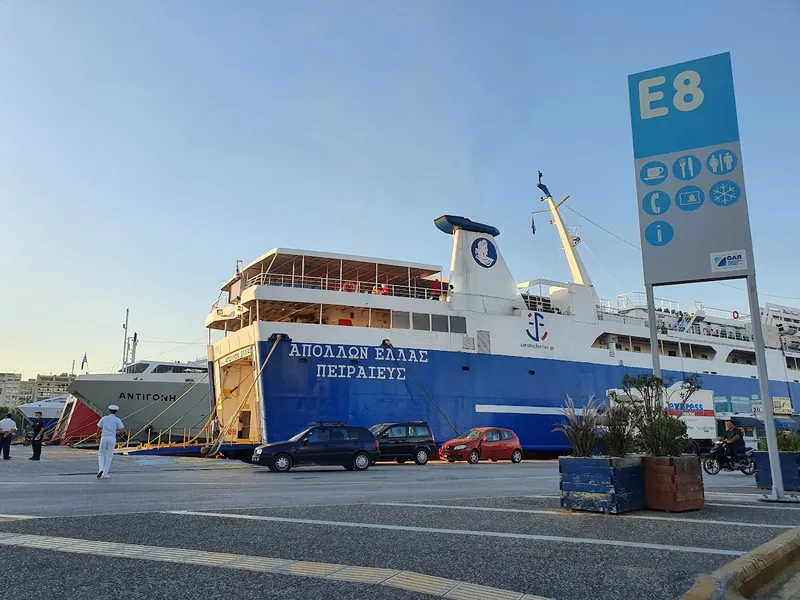
Piraeus is a port, not an airport. The waterfront runs for roughly 2.5–3 km, with gates along it. Arriving at the metro is not the same as arriving at your gate, and a wrong gate with luggage can mean a long walk and a missed boat.
Gate assignments change by season and by day. Check twice: the evening before, and again on the electronic boards at the port entrance on travel day.
How to find your gate, in order
- Your ticket or e-ticket. The gate is printed there. Read it first.
- Operator app or email. Same-day changes arrive there. Keep notifications on during travel week.
- Electronic boards at the port entrance. They show the live berth for each departure, and they are the most reliable view on the day.
- Port information desk. Ask early if you are unsure. Staff handle exactly this kind of question.
- The free shuttle and a port map help if you need to reach a far gate quickly.
Do not memorise a gate from a guide written months earlier. Operators move between berths, especially in high season.
Which gate serves which islands (orientation only)
Operator port maps (Blue Star, Hellenic Seaways, ANEK, and a January 2025 gate list) agree on most gates but not all. Where they differ, the table says so.
| Gate | Typical use | Notes |
|---|---|---|
| E1 | Dodecanese (Rhodes, Kos, Patmos); Blue Star Chios to Santorini, Heraklion and Karpathos | Far northern end; longest walk from the metro |
| E2 | North Aegean (Chios, Mytilene, Samos, Psara); some Crete sailings | Northern end |
| E3 | Crete (Chania, Heraklion); Milos (ANEK Elyros); Serifos (Asterion) | Northern end |
| E6 | Blue Star Paros and Naxos (passengers only) | Close to the metro |
| E7 | Blue Star Myconos (Mykonos, Syros, Ikaria, Samos); Seajets Champion Jets; vehicles for Paros and Naxos | Close to the metro |
| E8 | Saronic islands (Saronic Ferries, Alpha Lines, Hellenic Flying Cat) | One list puts Aero Highspeed here |
| E9 | Saronic islands (Aero Highspeed on the Blue Star and Hellenic maps); Seajets World Champion | |
| E10 | Western Cyclades and Samos and Ikaria (one port map) | Check the ticket |
| E11–E12 | Cruise terminals | Not general island ferry gates |
The simplest mental model:
- Crete: E2 and E3.
- Mykonos and most Cyclades: E6 and E7. Seajets high-speed sailings can use E9.
- Santorini: E6 or E7 on the Blue Star Naxos route, and E1 on Blue Star Chios.
- Saronic islands: E8 and E9.
- Dodecanese (Rhodes, Kos): E1.
- Milos: E3 on the ANEK sailing, or E9 and E10 on some lists.
Treat this table as orientation only. Operators move between berths, and some high-speed operators publish a gate range rather than a single number. Your e-ticket and the live board are the authority.
A routine for checking
The evening before: - Open the e-ticket and note the gate, vessel name and departure time. - Check the operator's app or website for itinerary notices. Bad-weather changes are published sailing by sailing. - Screenshot the ticket, gate, ship name, departure time and booking reference. - Note a backup: the next sailing from the same port.
On the morning: - Check the app and email again for changes. - Look at the port authority's departures page (olp.gr) if you have signal, or the port kiosks. - At the entrance, read the electronic boards before you walk anywhere. - If the boards disagree with your ticket, ask at the information desk.
If the gate changes on the day
- Read the board first. Do not start walking on the strength of an old list.
- Compare the old and new gates. Same end of the port: walk. Opposite ends, such as E6 and E1: use the free shuttle.
- Check the departure time. Has it changed, or only the berth?
- Phone the operator's port line if the change is unclear or you cannot reach the new gate in time.
- If you cannot make the boat, ask staff about the next departure rather than improvising.
The Port Authority's free shuttle bus leaves from the main entrance near gate E5 and stops at points including the suburban railway terminal, Agios Dionysios, Ietion and the bus terminus. Check the stop list on the port map before you rely on it for a far gate.
From the metro to your gate
- Line 1 ends at Piraeus. Line 3 runs to Piraeus and continues one stop to Dimotiko Theatro. Get off at Piraeus, because the station is opposite the central gates.
- Read the boards before you walk. Your gate may be a few minutes away, or a long walk in the other direction.
- Engineering works happen, so check the transport operator's notices if your connection depends on the metro.
- A taxi within the port can drop you at the gate. That is often worth the cost when the gate is far and time is short.
- If you arrive early, wait somewhere comfortable, such as a café or the waiting hall, rather than on the pier.
Common gate mistakes
- Treating "I'm at Piraeus" as "I'm at my gate." The port is roughly 2.5–3 km long.
- Memorising a gate from an old guide. Only the ticket and the live board count.
- Walking the whole port with a suitcase in summer heat. Use the shuttle or a taxi.
- Collecting a paper ticket at the wrong gate. If collection is needed, do it where the ticket or board says, and allow extra time.
- Expecting the shuttle to reach every gate. It serves the northern gates only.
FAQ
Which gate at Piraeus for Santorini?
It depends on the operator. Blue Star Naxos-route sailings leave from E6 or E7, and Blue Star Chios leaves from E1. Check your ticket and the day's boards.
Which gate for Mykonos?
Blue Star Myconos and the Seajets Champion Jets leave from E7. Blue Star Paros passengers use E6, with vehicles at E7. Seajets World Champion can use E9. Read the gate on your e-ticket.
Which gate for Crete?
E2 or E3, depending on the operator and the sailing. Heraklion and Chania sailings are the usual ones. Confirm on your ticket.
Which gate for the Dodecanese (Rhodes, Kos)?
E1, at the far northern end of the port. Confirm on your ticket.
Last checked
Gate patterns and shuttle details are given for orientation only. Confirm your gate on the ticket and on the day's boards before you travel.
Disclosure
This article contains practical recommendations and links that may qualify as affiliate links. If you book through an affiliate link, the site may earn a small commission at no extra cost to you. Affiliate links are not placed inside safety-critical steps.
Further planning
- Guide: How early should you arrive at Piraeus?
- Guide: Athens airport to Piraeus
- Guide: Common Piraeus mistakes
- Guide: Ferry cancelled due to wind
- Guide: Piraeus vs Rafina for Mykonos