Editorial guide
What happens if your Piraeus ferry is cancelled due to wind?
Short answer: A wind cancellation usually means a changed sailing rather than a refund. Fast catamarans are cancelled first, conventional ships keep sailing longer, and the operator will offer a later sailing (subject to availability) or a ticket change. EU passenger rights cover information and re-routing, but they can exempt operators from accommodation and compensation when weather endangers safe operation. Plan a spare day before any flight you cannot miss.
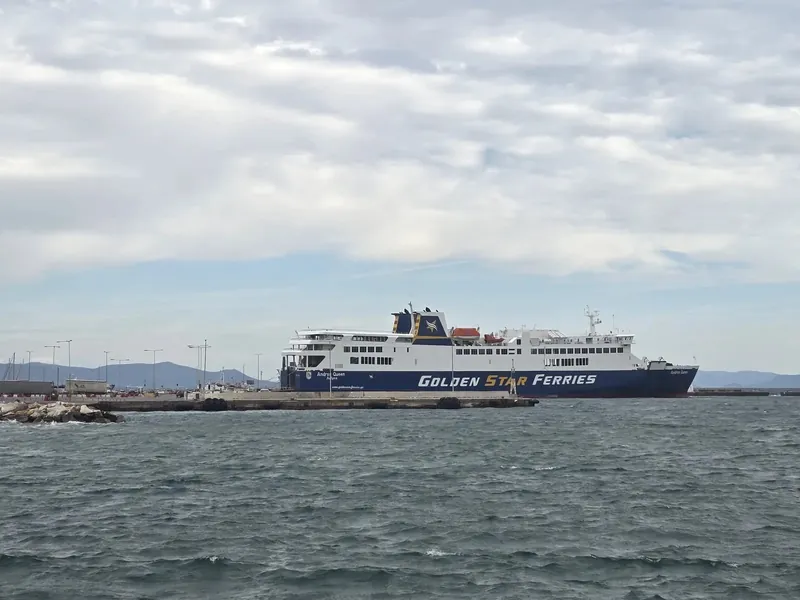
The meltemi is the usual cause. It is a dry northerly wind, so a cloudless morning tells you nothing about whether the ferry will sail.
Rules and operator practice change. Check the operator's current notice for your sailing.
What the meltemi does
The meltemi is a north wind that blows over the Aegean mainly from mid-June to early September. It is strongest in the middle of the day and in the afternoon, and it often eases at night. Winds of force 6 to 7 are common, and stronger gusts are possible in exposed straits.
The northern Cyclades (Mykonos, Tinos, Andros, Syros) are among the most exposed places. Piraeus is more sheltered than the open sea, but the route through the central Aegean is not. Piraeus can be calm while the sea on the way is not.
Which sailings are cancelled first
- High-speed catamarans are usually cancelled or slowed first. They are light, and they tolerate short, steep seas less well than larger ships.
- Conventional ferries keep sailing in stronger wind, which makes them the more reliable choice on a rough day.
- Sailing bans are set by port authorities for particular ports and vessel types. Large ships can sail while fast craft are stopped.
There is no published wind speed at which every Greek ferry stops. Each operator, port authority and captain decides on the day, based on the vessel and route. A single figure found online, such as "ferries stop at 8 Beaufort", is a rule of thumb rather than a rule. Morning departures are often calmer, because the wind tends to build through the day.
What operators do on a cancellation
Operators publish itinerary modifications for bad weather. Each notice lists the change for a sailing: cancelled, delayed, skipped port or re-routed. It also says whether a ticket change is needed. Notices are updated as conditions change, so the current notice for your sailing matters most.
In practice:
- A cancelled sailing's ticket usually has to be exchanged for a later sailing, subject to availability. Operators direct passengers to their port agencies for the new times.
- Re-routing is not always immediate. On a busy August weekend, the next available sailing may be the following day.
- Act quickly. When several fast boats are cancelled, many passengers want the same conventional sailing.
Your rights
Two sets of rules apply: EU Regulation 1177/2010 on sea passenger rights, and Greek passenger-rights law. Their details differ, so ask the operator or your agency which applies to your ticket.
In summary, under EU Regulation 1177/2010:
- Operators must tell passengers about delays and cancellations within 30 minutes of the scheduled departure.
- If a sailing is cancelled, or a departure is delayed by more than 90 minutes, passengers can choose re-routing or a refund.
- Refunds are due within 7 days.
- Snacks and meals are due in proportion to the wait. Accommodation (up to €80 a night, for up to three nights) is not due when weather endangers safe operation.
- Compensation for a late arrival is 25% or 50% of the fare, depending on how long the arrival is delayed. It does not apply in weather cases.
Under Greek rules, if a sailing is cancelled because of weather, you can usually change the ticket, stay on board if the captain allows it, or cancel for a proportional refund. Refund terms depend on your fare class and how much notice you give.
Neither set of rules gives a flight home. A weather cancellation does not cover a missed flight.
Practical steps on the day
- Read the operator's live notice for your sailing, not just the route.
- If you can still travel that day, queue at the port agency for the next sailing, from Piraeus or from Rafina. Do not rely on the website during the rush.
- Keep a reachable mobile number on the booking, and screenshot the notice and your ticket.
- Ask: is this a cancellation or a delay? Do I need a ticket exchange? What is the next sailing on this route? What are my options if I go by air instead?
- If the operator does not honour a refund or exchange, complain to the operator first, then to the authorities, within the time limits the rules set.
Carry your e-ticket screenshot, the notice, mobile data, a power bank and water. Do not rely on the port kiosk QR scanning in long queues.
Planning around it
- Plan a spare day between the last ferry and any flight you cannot miss. Operators commonly quote 4 hours as a minimum between ferry arrival and flight, but a day is much safer.
- From mid-June to early September, check the HNMS marine forecast and the operator's notice the day before and on the morning of travel.
- Check the wind for the hour you sail, not just for the day.
- A large conventional ship is usually the safer choice on a windy forecast.
- Island airports can be a backup, but check for winter closures and baggage rules.
FAQ
Do ferries run during the meltemi?
Usually yes, but with delays, skipped ports and cancellations mixed in. Check the notice for each sailing.
At what wind force are ferries cancelled?
It depends on the route and the vessel, and it is decided on the day. High-speed craft are affected first, at lower wind strengths than conventional ships. Treat any single number as an approximation.
Do I get a refund if the ferry is cancelled for wind?
Usually you can exchange for a later sailing, subject to availability, or cancel for a refund under the rules above. Accommodation and extra compensation may not be payable in weather cases. Check your ticket conditions.
Can I take a conventional ferry instead of the fast one?
Often yes, if there is space. Ask the port agency or operator, because a conventional sailing may sell out quickly after a cancellation.
Last checked
Rules and operator practice change. Verify your sailing and the current regulation before you travel.
Disclosure
This article contains practical recommendations and links that may qualify as affiliate links. If you book through an affiliate link, the site may earn a small commission at no extra cost to you. Affiliate links are not placed inside safety-critical steps.
Further planning
- Guide: How early to arrive at Piraeus
- Guide: Which gate at Piraeus
- Guide: Common Piraeus mistakes
- Guide: Fast ferry vs conventional
- Guide: Piraeus ferry + flight same day
- Guide: Piraeus vs Rafina for Mykonos