Editorial guide
Can you take a bicycle on a ferry from Piraeus?
Short answer: Usually yes, but only as a declared item on a ship with a garage. Most conventional car ferries will take a bicycle, often free of charge or at a token fee if it is entered on your vehicle/baggage line and falls within ordinary bike dimensions. High-speed catamarans without garages can refuse bikes on the day, and some operators say this explicitly on their booking flow. Check before you book, especially in July–August. Treat the ship type, not the island route, as the governing question.
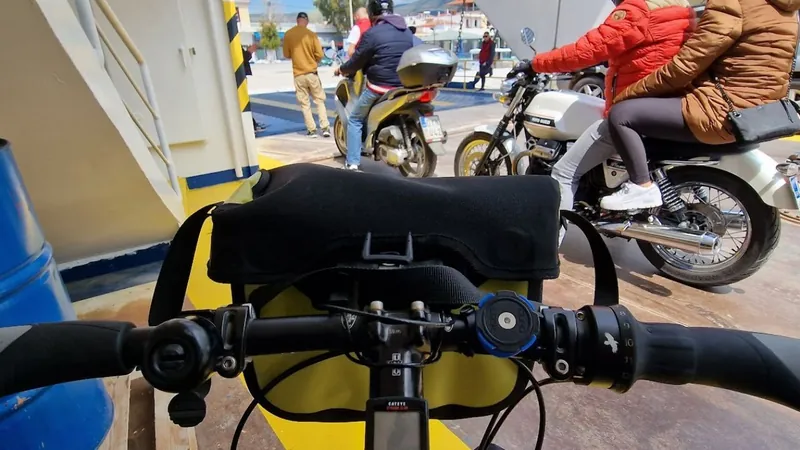
Bike, battery and dangerous-goods rules are operator-governed. Confirm the exact sailing's policy before you rely on it.
The rule that actually decides your bike trip
| Vessel / setup | Common position | What to do |
|---|---|---|
| Conventional ferry with car garage | Usually carries bikes in the garage; often free when declared as a "bicycle" rather than a "vehicle" | Add it to booking; arrive early; obey marshalling signs |
| Conventional ferry, no clear garage or bike space | May accept it as checked luggage if folded/bagged compactly; sometimes oversized-bag fee | Email or call the line before payment; take a packable bike bag photo |
| High-speed catamaran without garage | Boarding of full-size bicycles is often refused on the day because there is no safe lashing point or garage | Do not assume; book a conventional ferry on that leg or rent at the destination |
| Foot-passenger terminal to car deck transfer | Bike wheels are often not permitted in passenger circulation during peak loading | Follow vehicle-desk instructions; go where marshals point, not where the ramp is fastest |
The practical shorthand: garage ships usually say yes; garage-less high-speeds often say no. Operators set this by specific hull and season, not by destination.
How to declare and store it
- Declare it at the time of booking, even when the price is zero. An undeclared bike can be refused at loading.
- If the booking form only offers "passenger," look for an "additional products" or "bicycle/disability/mobility aid" line, or ask your aggregator's help desk for the operator's bike line and save the answer with your booking reference.
- Measure the fully loaded bike: handlebars, rack, panniers and a compressed tyre can take a bike past ordinary "bicycle" dimensions. Declare the larger of the bike or the bagged bike.
- Storage on board:
- Vehicle deck: typically offered as wall-rail lashing or bike rack space; confirm with marshals where the bike lives, since the car deck is closed under way and you cannot fetch it mid-crossing.
- Keep tools, pumps and spare bits in your cabin or seat bag, if the bike is below deck and the ramp opens at destination, you will not have access.
- Remove front lights and clip-on accessories in the port; protruding parts are easily damaged when bikes are tied against vehicles or rails.
- A padlock helps if the bike is loose in a communal area; secure it only where it does not block emergency access or another vehicle's space.
- At disembarkation: bikes usually go off last; do not position in front of ramp doors, as vehicle deck handling runs first.
E-bikes, scooters and batteries
- Full-size e-bikes and hired e-MTBs are still bicycles legally on most tourist ferries, but their battery is a specific safety matter once on board.
- Disclose e-bike status at booking; some operators place conditions such as battery not charged on board, no plug connection, or limits around the carriage of additional standalone packs.
- Standalone lithium batteries and spare packs in your cabin should follow the same care you would at an airport: protected from short circuit, in original packaging or a battery safe bag, and never left in direct island sun.
- Do not attempt to charge an e-bike or motorised scooter on board unless the crew point to an explicit charging point; vehicle-deck charging on Greek ferries is generally not authorised and is an easy way to be refused.
- "E-scooters" and "electric mopeds" live in a different and more restrictive category than e-bikes and should be checked with the operator directly, with serial number, power rating and weight declared.
Arrival, packing and bicycle comfort
- Allow more time at Piraeus with a bike than on foot. Bike handling, the walk between gate and dock, and any check-in at the vehicle desk all add time.
- Follow marshals' instructions at Piraeus: gate numbering matters more on wheels, because cycling in the traffic lanes is not realistic at the harbourfront.
- If you cycle into port, check your gate before locking up, and lock up only at a signed parking point, if the port has one.
- Salt and spray damage chains and electronics. Where possible use an interior stow point or a vehicle-deck tie, and wipe the chain and battery contacts on arrival.
- Remove loose accessories (lights, pumps, bags) before loading; they are the parts most often lost or damaged in the garage.
When a bicycle does not make sense
Sometimes the worst risk is logistical rather than physical:
- Multi-island chains (Paros, Naxos, Amorgos, Santorini) add loading days and raise the chance of a missed ferry. The bike does not ride itself back.
- Fast-ferry hops across the Aegean: a €70–90 high-speed may have no bike space, and the conventional alternative can add €30–50 and half a day. Compare the bike cost with renting on the island.
- Rent locally for short island legs. Many Greek islands rent e-bikes and standard bikes at roughly €15–30/day, which is often cheaper and simpler than shipping your own.
- Islands with no rentals: carry the bike, if you will ride it there.
FAQ
Are bicycles usually free on Greek ferries?
Often yes, when declared as a bicycle on a garage ferry, or charged a nominal fee depending on operator. A bike still needs its own declared entry. An undeclared bike is not covered just because it travels free.
Can I bring a folding bike on a high-speed from Piraeus?
Sometimes. A folded and bagged bicycle can be accepted as compact luggage by some crews; a full-size bicycle on a garageless high-speed usually is not. Verify with the operator, in writing if possible, rather than relying on port gossip.
Do I need a separate ticket for my bike?
Often no extra charge, but the booking step is required. Some booking systems do not show a bicycle field. If yours does not, confirm by email with the operator before paying, not at the ramp.
Can I take an e-bike on a Piraeus ferry?
Usually yes on a conventional ferry, with battery disclosure advised and no on-board charging unless crew direct you to a designated point. Treat spare batteries like carry-on lithium batteries.
What does "high-speed may not carry bikes" mean in practice?
It means the ship design lacks garage tie points and vehicle-deck storage, so the crew can refuse on arrival on safety grounds. The risk is not a charge, it is being left behind at the end of a planned day.
What paperwork or ID do I need for a bicycle crossing?
For the bicycle, declare its dimensions and whether it is electric. For you, bring your ticket and ID. A standard bicycle normally needs no road insurance or vehicle registration, but cargo bikes, bike boxes and commercial equipment may fall under different freight rules; ask the operator.
Last checked
High-speed denials, bike-line fields and battery conditions vary by ship, season and operator and can change without notice. Reconfirm with your exact sailing.
Disclosure
This article contains practical recommendations and links that may qualify as affiliate links. If you book through an affiliate link, the site may earn a small commission at no extra cost to you. Affiliate links are not placed inside safety-critical steps.
Further planning
- Guide: How to take a car on a ferry from Piraeus
- Guide: Common Piraeus mistakes
- Guide: Which gate at Piraeus
- Guide: Fast ferry vs conventional
- Guide: Piraeus port mistakes that cause missed ferries
- Guide: Aegina day trip